The browser you are using is not supported. Please consider using a modern browser.

Article
The Quiet Spread: Seven Months Later
 •
Sep 14, 2026
•
Sep 14, 2026
In May we published The Quiet Spread: Four Months Later, showing that deposits across our community bank clients were flowing steadily to crypto platforms, and that the market sets the pace of the flow.1 That analysis left one question open: what happens in a real crash? Does the money come home?
It did not. Bitcoin lost half its value from its 2025 peak to the June 2026 low. Customers kept sending money out anyway, brought less of it back than ever, and the outflows were re-accelerating before the market had even found its bottom. Twenty-one months of data now cover a full boom and a full bust, and the answer is the same on both sides of the cycle.
Put plainly, for a bank CEO: you do not face crypto deposit flight today. You face a visible customer habit that can become a liquidity issue, and the distance between those two is one act of Congress.
That answer lands one week before it matters most. On September 15, the Senate takes a procedural vote on advancing the CLARITY Act, and inside that bill sits the provision that determines whether platform reward programs, advertised today at 4 to 6 percent, stay lawful. Here is what the data says, and what to do before the 15th.
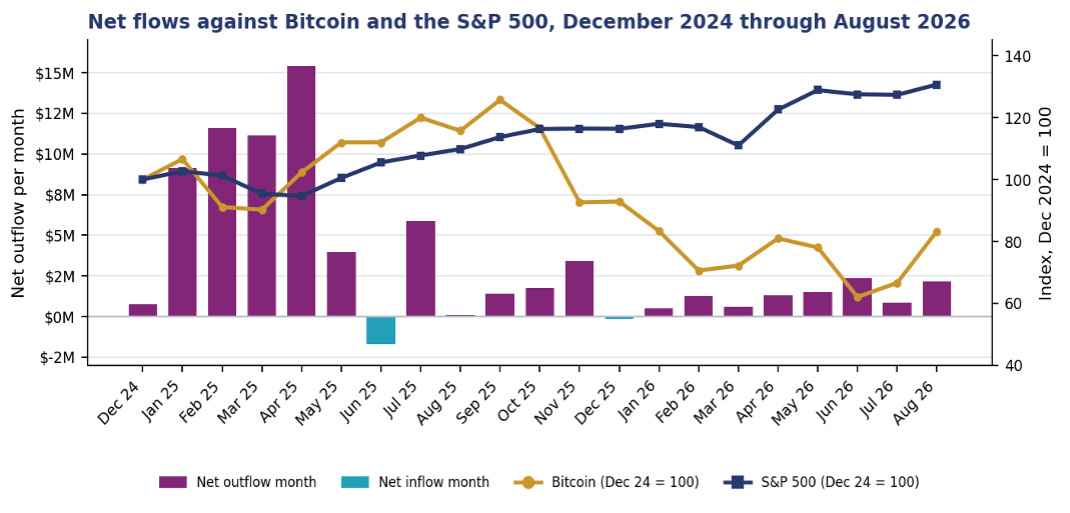
Net monthly flows at the original banks against Bitcoin and the S&P 500. The dollars swing with the market; the direction does not.
Three Findings
- Crypto platforms are now permanent infrastructure in your deposit base. Across 21 months, roughly nine of every ten transactions we can classify ran out of the bank, and that share held in every single month, rally and crash alike. Customers transacted almost as often at the bottom of the bear market as at the top of the bull. They send smaller amounts when prices fall. They do not leave.
- The market changes the size of the flow. It has not changed its direction. The net drain, about $73 million more out than back over the window, is roughly 0.12 percent of the $60 billion these banks averaged in demand and savings balances across it. Small, because speculation is the only motivation on offer, and speculation partly refunds itself when prices run. But these rails have shown what they can carry: $15.4 million net out in a single month, April 2025, when customers had a reason to move. Nothing structural sets that pace. The price does.
- One vote determines whether the question reaches the floor, and one provision frames the answer. The GENIUS Act bans stablecoin issuers from paying interest but leaves exchanges outside the ban, and Coinbase pays rewards through that gap today, a business worth roughly $1.35 billion a year to it.2 The CLARITY Act’s Section 404 compromise prohibits yield on idle balances but carves out activity-based rewards.3 If the carve-out survives, platforms can continue building reward programs at the rates already advertised in the market, 4 to 6 percent, with the law’s blessing, aimed at the deposits that fund 60 percent of the nation’s small business loans under $1 million and 80 percent of its agricultural lending.4
What the Money Did
Customers use these pathways as a one-way valve. Over twenty-one months they sent $161.6 million out and brought $88.2 million back, a net of $73.4 million: $1.83 left for every dollar that returned, nine of every ten classified transactions moved outward, and three of every four banks we can measure lost deposits to the pathways on a net basis. The chart on the first page tells the whole story in one frame: the bars are the monthly net flow, the lines are Bitcoin and the S&P 500. Equities climbed 31 percent and set records. Bitcoin round-tripped from $94,000 to $119,000 to $59,000 and back to $79,000. The bars stayed on the outflow side in 19 of 21 months, through all of it.
Only two months in twenty-one ran net-in, June and December of last year, and both were marginal: some profit-taking near a run-up, a pause into year-end. The money has never come home for longer than a month at a time.
The Ratio: Crypto’s Pulse Inside Your Deposit Base
In May we tracked the dollars-out-per-dollar-in ratio as the cleanest single measure of the flow. Re-measured on the original banks under the current extraction (see Methodology), four more months confirm the pattern on both sides of a full cycle. The ratio ran between 4 and 6 through the rally, peaking above 6 in March 2025. It compressed toward balance as the bear market deepened, touching 1.19 in the first quarter of 2026, the closest these pathways have come to two-way traffic. The re-expansion began in April, while Bitcoin was still searching for its low, and held through the summer, reaching 1.94 in August. The ratio compresses when prices fall and widens again as they recover. What it has never done is flip.
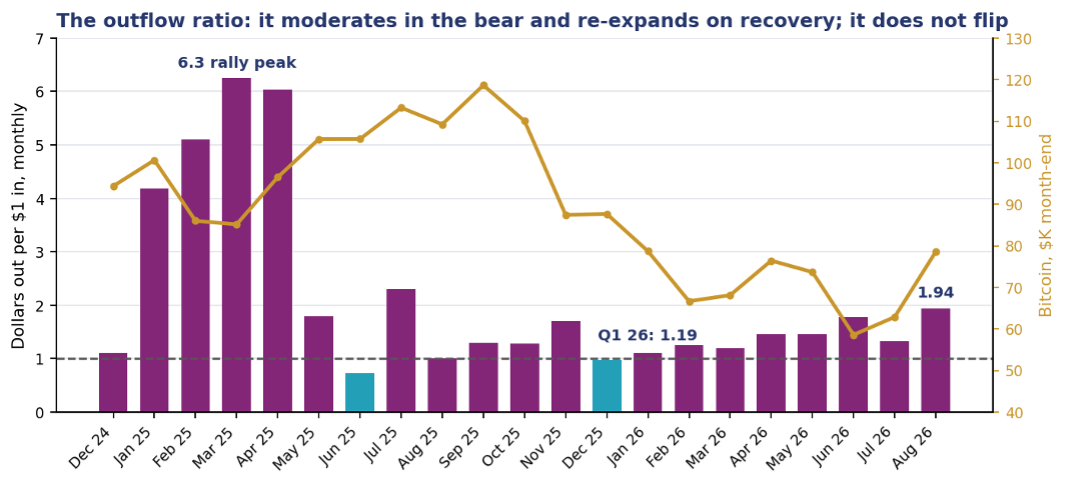
The monthly outflow ratio against Bitcoin. It compresses in the bear, re-expands on recovery, and never sustains below $1 out per $1 in.
What Changed Since May
Money kept leaving all summer. At the original banks we have tracked from the start, about $7 million more went out than came back from May through August, and every single month ended net-out.
When Bitcoin fell, customers did not bring their money home. More than 9 of every 10 crypto related transactions that moved still went out, the highest sustained stretch of the entire 21 months. The bear market made the pathway more one-directional, not less.
The big money market moves stopped. During the rally, money market customers moved about $3,300 at a time. This summer it was about $700 at a time. The channel stayed open; the checks got small.
And the dollars shrank while the habit held. Comparing the same banks summer to summer, $18 million moved out this May through August against $31 million a year ago, on activity down just 4 percent.
Which Deposits Move: The Rate-Sensitivity Gradient
The product story from May held up, and the bear market added a wrinkle to it. Money market accounts remain the most one-directional product on the books: 97.4 percent of their classified transactions run outward, at an average of $3,278 per outflow, which is what rate-aware money looks like when it treats crypto platforms as one more place to chase yield. Checking carries the volume in small tickets, averaging under $400; money market carries the intent. And the bear market added the newest wrinkle: the average money market outflow fell from about $3,300 during the rally to about $700 this summer. The rate-sensitive mover sizes the check to the market. Give that mover a lawful reason paying what platforms advertise today, 4 to 6 percent, and the economics change significantly.
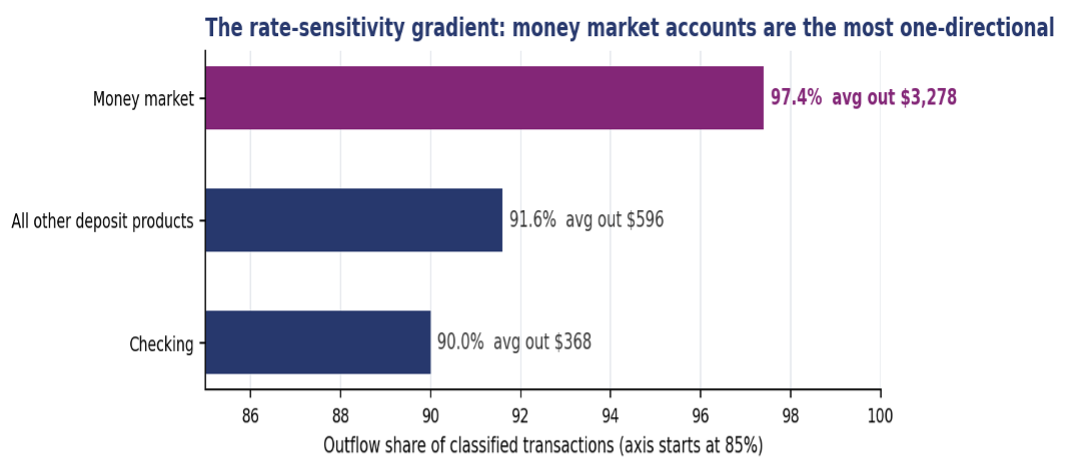
Outflow share of classified transactions by deposit product. Money market accounts lead; detailed mapping of the remaining product groups is being finalized.
Section 404: The Window Is Down to Days
Washington has moved twice since May. The Senate Banking Committee advanced the CLARITY Act 15 to 9 on May 14, the day after our last update, on the Section 404 compromise: no yield on idle stablecoin balances, activity-based rewards permitted.5 The banking coalition called it a step and pressed for the rewards gap to close.6 The Senate left for recess without a floor vote, and cloture on the motion to proceed is scheduled for September 15, the day after the chamber returns, at the 60-vote threshold.7 The rewards provision is one of three disputes still dividing negotiators, and prediction markets have cut the bill’s 2026 chances from over 80 percent at the start of the year to the teens.2 If the motion fails, the question waits until after the midterms. Either way, the flows in this paper keep running.
Five control points, before the 15th and after it. Pull your own last 12 months of activity on the seven platforms named here, by product and direction, and put the money market number on the next ALCO agenda. Brief your board with your institution’s figures, not industry averages. Review which customer segments carry the habit; the data says rate-aware money market holders lead it. Factor the demonstrated throughput into your liquidity plan’s deposit assumptions. And call your senators before Tuesday: the Section 404 carve-out is the exact language in play, ask for it to be closed, and bring the number you just pulled.
In May we laid out the four-stage trajectory: speculation, then payment stablecoins, then yield-bearing balances if the law allows them, then tokenized money funds. Twenty-one months of data now show stage one surviving a full bear market intact. Stage three is on the Senate floor Tuesday.
The spread is still quiet. The pathways do not close; only the reasons change. Congress is deciding whether to hand them a permanent one.
A note on populations before the fine print: the May update drew on our full multi-platform dataset, then 122 institutions, and tracked the original banks inside it; this piece deliberately narrows to that original group of banks, so every figure is same-bank continuity rather than network growth, and what May counted as 84 original banks still in its dataset is this same cohort, counted as 86 under the current extraction.
Methodology
This analysis is based on transaction-level data extracted from databases across our client base of more than 150 community banks. Transactions are identified by description field matching for seven crypto platforms (Coinbase, Kraken, Gemini, Crypto.com, Bitcoin Depot, Crypto Hub, and Binance; Gemini matches require an accompanying qualifier to avoid false positives), aggregated by institution, date, product group, and direction. The population is the original cohort of 92 institutions that these updates have tracked from the start and that the May analysis continued to follow; 86 remain in the dataset, 94 percent of them active this year, and the series runs December 1, 2024 through August 31, 2026. Directional analysis is possible for 55 of these banks where transaction code mappings are available; their end-of-month demand and savings balances (excluding CDs and IRAs) total about $65 billion as of August 2026. Summer-over-summer comparisons use the 53 banks with directional data in both periods. Three institutions have interior data-feed gaps; their figures are treated as conservative floors. Individual bank names are anonymized. This is an observational analysis of available client data, not a randomized or stratified study; it reflects the seven named platforms only and excludes direct stablecoin holdings and peer-to-peer transfers, so total crypto-related movement is understated. Figures in each edition reflect the extraction, population, and transaction code mappings as of its publication date; the May analysis computed its flow and ratio figures across its full multi-platform dataset, so those published figures are not directly additive or comparable with the cohort figures here. Bitcoin and S&P 500 series are FRED month-end values.8
Sources
- Bankers on Chain and KlariVis, “The Quiet Spread: Four Months Later,” May 13, 2026.
- crypto.news, “The CLARITY Act vote lands September 15,” September 6, 2026 (prediction-market odds; the three unresolved disputes; Coinbase USDC rewards revenue of roughly $1.35 billion annually).
- Latham & Watkins, US Crypto Policy Tracker: Legislative Developments (Senate Banking Committee bill text of May 12, 2026, and markup of May 14, 2026).
- ICBA, “About Community Banking,” icba.org.
- ABA Banking Journal, “Senate Banking Committee advances Clarity Act,” May 14, 2026.
- Bank Policy Institute, “Banking Trades Statement on Senate Banking Committee Vote to Advance Clarity Act,” May 14, 2026.
- The Block, “Majority Leader Thune files cloture on Clarity Act, setting up Sept. 15 Senate vote,” August 8, 2026.
- Federal Reserve Bank of St. Louis (FRED), Coinbase Bitcoin-USD (CBBTCUSD) and S&P 500 (SP500) daily series, month-end values, December 2024 through August 2026.