The browser you are using is not supported. Please consider using a modern browser.

Webinar
ON DEMAND: Stablecoins, Digital Assets, and Your Bank
Recorded on May 27, 2026
Not every webinar is worth your hour. This one is.
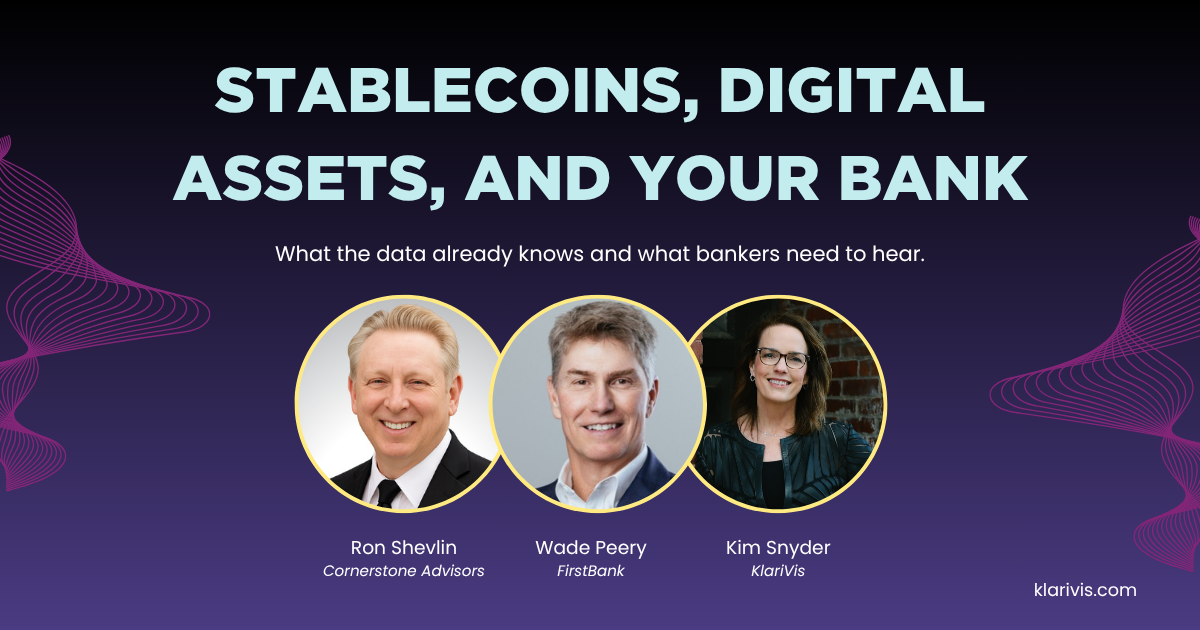
On May 27, 2026, Kim Snyder, founder and CEO of KlariVis, sat down with Wade Peery, banking consultant, digital assets strategist, and advisor to the ICBA on stablecoin policy, and Ron Shevlin, Chief Research Officer at Cornerstone Advisors, to make the case that stablecoins are not a future problem for community banks. They are a present one.
Here’s what we covered.
What the Data Is Already Showing
We started with the numbers. In our updated research, The Quiet Spread, Four Months Later: Already on the Trajectory, KlariVis analyzed transaction data across 122 community banks and found that 93% already show meaningful crypto platform activity from their customers. Among banks where transaction direction could be determined, customers moved approximately $155 million to crypto platforms while only $76.5 million came back. That 2-to-1 outflow ratio held across a full crypto market cycle. When Bitcoin fell, the ratio moderated, it did not reverse.
The most striking finding: 96% of those outflows came from money market account holders — the more affluent, rate-sensitive customers who accepted friction for yield once and are doing it again. Most bankers assume this is a Gen Z and millennial story. The data says it is not.
Complacency Is the Wrong Response
Wade has spent the past year presenting this data to community bank CEOs. The most common reaction is a shrug. Having spent his entire career as a practitioner — and the last several years deeply embedded in the digital assets space through his consulting work with the ICBA and his tenure as former board chair of the USDF Consortium — Wade was candid that he understood that instinct. Bankers have always operated inside a charter that functioned as a moat. Rules changed, institutions adjusted, and the system held. That framework no longer applies.
Ron shared research during the webinar that puts numbers to the same problem. He estimates $3 trillion in deposits have moved out of banks and credit unions since 2020, with 60% driven by Gen Xers and baby boomers moving in low-frequency, high-dollar transactions. In Cornerstone’s annual banking survey, only 29% of executives cited crypto providers as a significant competitive threat over the next five years — while 80% named big fintechs, a figure that jumped from 64% in a single year. Fintechs now capture more than half of all new checking account openings, and Ron noted that SoFi alone opened more new accounts last year than all community banks combined.
The main interpretation: bankers who are predominantly commercial-focused still read crypto as a retail threat aimed at younger consumers they don’t compete for. They are not yet tracking the commercial and small business exposure. And when they dismiss the fintech numbers because deposit balances are still relatively small, they are missing the more important point. Fintechs are capturing payment behavior. Lose sight of how your customers move money and you lose the insight that makes relationship banking possible. Wade added that nearly 25% of Gen Zers and Millennials already hold 50% or more of their investment assets in crypto — and community banks with their own wealth management arms are already seeing that shift in their transaction data.
The Legislation Is Moving Whether Banks Are Ready or Not
Few people are better positioned to read the legislative landscape than Wade. He consults directly for the ICBA, works alongside banks navigating this in real time, and has spent years inside the policy conversations shaping how digital assets intersect with the banking system.
His read on Section 404 of the CLARITY Act — which survived the Senate Banking Committee markup intact — is that it is not the win for banks that early headlines suggested. The provision permits crypto exchanges to pay yield to users through rewards or membership programs, with the requirement that payments not be calculated or distributed exactly like bank interest. The inputs the legislation does permit — duration, balance, and tenure — are the same ingredients that go into interest calculations.
The broader regulatory picture is equally pointed. The Genius Act, the Clarity Act, the OCC’s work on national trust charters, and the Federal Reserve’s recent proposal for limited-purpose payment accounts that would give non-bank financial institutions direct access to Fed payment rails are all moving in the same direction at the same time. Wade’s framing was direct: this administration wants innovation. Banks treating regulatory clarity as a prerequisite for action are making a strategic choice — they just may not be recognizing it as one.
The Threat Is Structural, Not Speculative
The most important reframe of the conversation came when Wade pulled back from the stablecoin debate and described what is actually changing underneath it. The issue is not speculative investment. It is a ledgering system that, for the first time, moves money across the internet without bank ownership. When that ledger can hold tokenized assets, support programmable payments that execute automatically, and offer rewards that function like yield, it becomes a competing financial operating system, not a crypto product.
What a Bank’s Strategy Actually Needs to Include
Wade laid out a three-pillar readiness model that represents roughly twelve months of work for most institutions. The first pillar is technology — a platform that sits alongside the core and enables connectivity to digital asset infrastructure, including compliance tooling. The second is operations — board governance, liquidity policy, BSA/AML, and third-party risk management. The third is products — understanding blockchain and distributed ledger well enough to recognize where existing processes can be improved, and then building offerings customers will actually use.
Ron’s balance sheet framing was equally direct. Stablecoin-adjacent deposits should be modeled as hot money — not because they are bad deposits, but because they will move. That means planning for higher runoff risk, setting concentration limits, and building triggers that require senior review when certain balances cross a threshold. Also, the idea of core deposits as inherently sticky may no longer hold. In a world where yield-seeking customers have low-friction alternatives, everything carries more runoff risk than it used to.
Both agreed that no community bank should try to build this infrastructure alone. The consortium path is worth watching — Wade noted active explorations underway across the industry — but unanswered regulatory questions and the scale required make it a complicated road. The most defensible immediate step is also the most straightforward: understand what is already happening inside your own customer base.
What Banks Can Do Right Now
Wade’s closing advice was unambiguous. Look at your transaction data. The exchanges are identifiable. Call the customers who are already moving money and find out why. There is no defensible reason for not having done that already.
Ron added that vendor conversations cannot wait. Banks need to be sitting down with their cores and key technology providers now, asking directly about roadmaps and timelines for digital asset support.
Dive in further:
KlariVis ran this analysis across our entire client base. Here’s how to do it yourself.
The full, original research behind this conversation is available here: The Quiet Spread: What Transaction Data Reveals About the Stablecoin Impact on Community Bank Deposits and Lending.