The browser you are using is not supported. Please consider using a modern browser.

Webinar
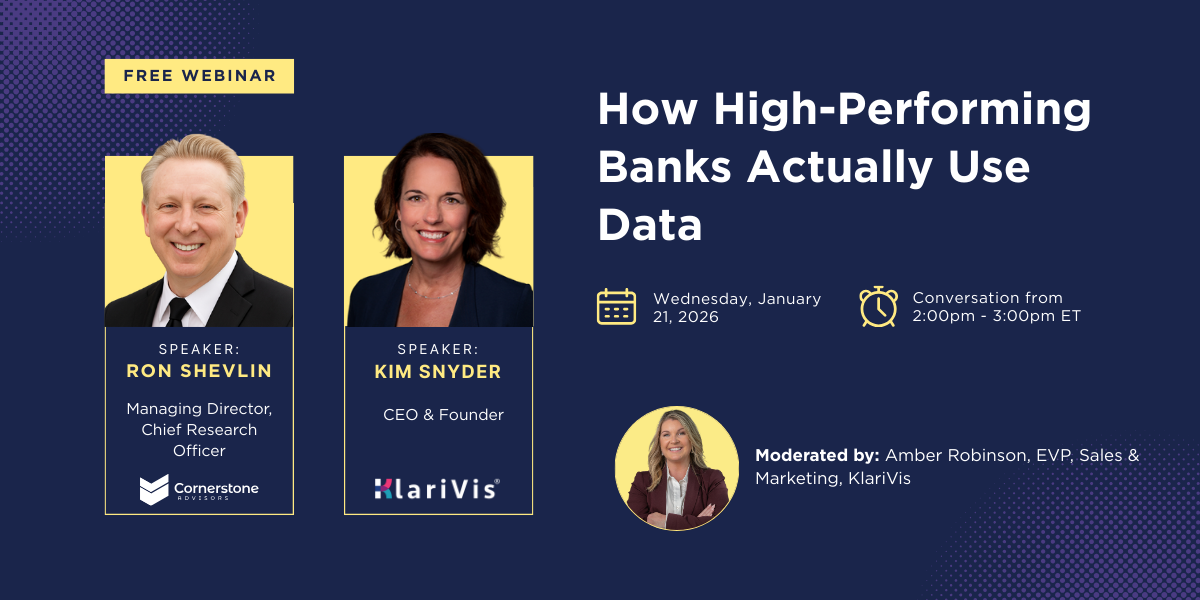
WATCH: How High-Performing Banks Actually Use Data
Recorded on January 21, 2026
The gap between having data and using it effectively continues to widen in banking. Banks have invested millions in data infrastructure, but frontline employees still can’t get what they need to make confident decisions.
In this webinar, Ron Shevlin, Managing Director & Chief Research Officer at Cornerstone Advisors, and KlariVis CEO & Founder Kim Snyder tackle a problem every community bank faces: we’ve invested in the tools, our people are hungry for insights, but nobody knows what to actually do with all this data once we have it.
Moderated by Amber Robinson, EVP, Sales & Marketing at KlariVis, the conversation gets real about the cultural barriers holding banks back, why security concerns can create paralysis instead of protection, and the practical steps executives can take starting tomorrow to shift from data collection to data execution.
Webinar Recap
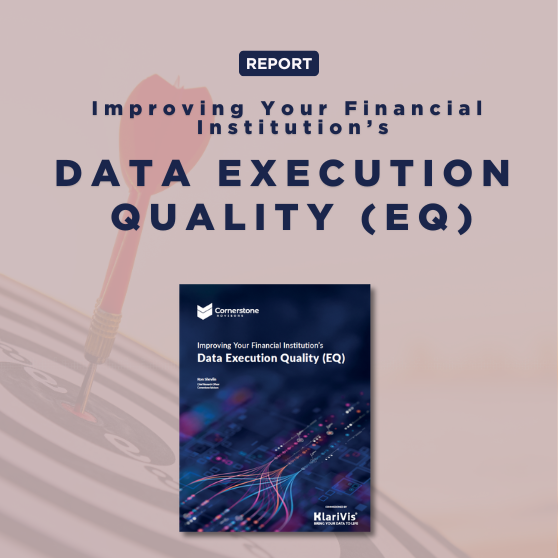
The Data Execution Quality research commissioned by KlariVis and conducted by Cornerstone Advisors makes one thing clear: community financial institutions are hardly halfway to where they need to be when it comes to actually using their data. The average score was 241 out of 500.
The research looked at how banks use data across five areas: credit analysis, sales and marketing, strategic planning, operational delivery, and data access and analysis. For banks, credit analysis came out on top with an average score of 45. Sales and marketing came in at dead last, scoring just 36. Predictive churn analytics — the ability to identify which customers are about to leave — scored just 3.79 out of 10.
Ron and Kim discussed five core themes that separate high-performing institutions from everyone else:
1. Culture eats technology for breakfast
Ron called out the phrase, “banking is a relationship business” as an excuse to avoid process improvement. “It is a relationship business, but it doesn’t mean that it has to be created and supported strictly by people. It’s processes, it’s technology, it’s the experience.”
Kim saw this play out during the SVB crisis. KlariVis clients who could see deposit movements in real time picked up the phone immediately, reassured customers, and watched deposits come back. Banks that had to wait days for someone to build a report? They were already too late.
2. Data ownership can’t live in one department
The most successful banks move data ownership out of IT and into the hands of functional leaders. When data lives with one person or one department, the organization isn’t ready to become truly data-driven.
Kim emphasized that data is a bank’s most valuable technological strategic asset. “Why do you want to keep that locked up in one department? In order to truly be successful with any kind of data program, it has to be baked into the DNA of the organization’s leadership structure.”
The best implementations? CEOs who made it clear from day one: “Do not come into my office with a recommendation unless you’ve got data to support it.”
3. Security concerns can create paralysis
Banks that lock down data so tightly in the name of risk management that nobody can actually use it aren’t protecting anything. “The result of that is not protection, it really is paralysis,” Kim said.
4. There is no AI strategy without a Data EQ strategy
“There’s a massive gap between the hype and the reality,” Kim mentioned. “If you read the headlines, it sounds like every bank is deploying AI, but on the ground, most community banks are hardly even experimenting with it.”
Ron was direct: “If your data quality is low, your AI strategy will blow.”
AI depends on clean, unified, well-governed data. If your data means something different across five systems, your AI tools will just amplify the mess.
5. Ask for the story, not the data
Executives need to stop asking their teams for “the data” and start asking “what’s the story?” It’s one of the simplest but most powerful shifts discussed.
When you ask for the data, you get spreadsheets. Now you have to do all the work of figuring out what it means. When you ask for the story, you push the responsibility for analysis and interpretation down to the people closest to the work.
Kim added an important caveat: whoever builds the report gets to tell the story they want to tell. They can cherry-pick data to justify their points. “That’s dangerous. You need both. You need an automated, consistent reporting structure that takes the spin out. But then you also have to ask for the story.”