The browser you are using is not supported. Please consider using a modern browser.

Article
The AI Readiness Gap in Banking
 •
Dec 1, 2025
•
Dec 1, 2025
I use ChatGPT, Claude, and other AI tools every day for my job duties. I read product updates from Anthropic, OpenAI, and Google proclaiming the latest model release that will revolutionize professional workplaces every week. And I know that our largest financial institutions have departments of data scientists, engineers, and AI leaders that have moved well past chatbots and are implementing generative AI tools and prescriptive analytics to their frontline staff in an arms race to win more banking customers.
But at our most recent Executive Data & Innovation Summit, we asked the bankers in the room (~35) a straightforward question: Is your bank ready to experiment with AI in a meaningful way? Despite all the personal experimentation and industry momentum, most institutions remain cautious. “We’re looking into it.”
That caution is wise from multiple perspectives. The perspective I want to highlight relates to your data and the journey needed to support your business’s transformation into an AI-first world (whether that is in 6 months or 5 years).
The Data Problem Nobody Wants to Talk About
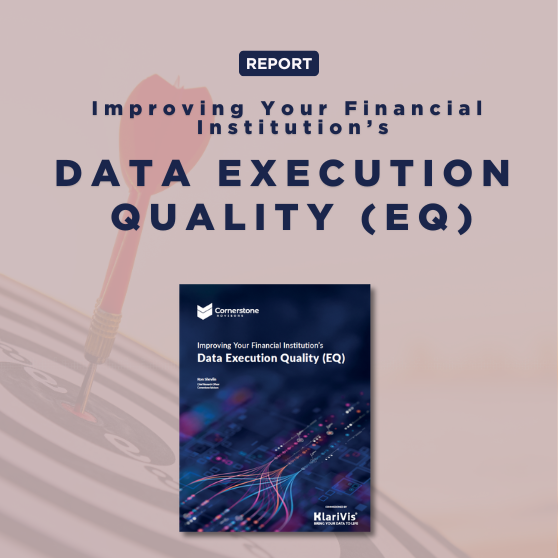
A new report we commissioned with Cornerstone Advisors surveyed over 100 banks and credit unions to measure a financial institution’s Data Execution Quality, or “Data EQ.” The focus wasn’t just on whether institutions have data but whether they can actually use it to make decisions, serve customers, and run operations. The average score was 241 out of 500, which means most community institutions are about halfway to where they need to be.
Credit analysis scored highest, which makes sense given that banks have been underwriting loans with data for decades. But sales and marketing scored lowest, with two-thirds of institutions rating below “developing and improving” in how they use data to understand customers, personalize offers, or measure campaign effectiveness. The gap isn’t about technology but execution, and Ron Shevlin, who authored the report, put it directly: “There is no AI strategy without a data strategy.”
With the context of my current role at KlariVis, there is nothing more accurate than that statement.
Why AI Amplifies Everything You Already Have
Community banks stand to benefit from AI in meaningful ways through fraud detection, loan underwriting, operational efficiency, and personalized marketing, to name just a few areas. These aren’t theoretical use cases but real applications happening now. Some of those use cases are being realized across most asset sizes, others only at larger institutions. They are providing benefits because banks have spent years building the data infrastructure underneath those areas.
The Cornerstone report breaks this down across four functional areas: strategic planning, sales and marketing, credit analysis, and operational delivery. Then it adds a fifth category for data access and analysis, which serves as the foundation everything else sits on. High performers in the study didn’t just have better access and visualization into performance. They treated information as a strategic asset, with nearly three-quarters of high performers saying that statement described their culture, compared to just 3% of low performers. They deemed data governance as a mission-critical process, made data a key driver of decision-making, and reviewed data quality regularly. Data strategy carried the same importance as financial and business strategies at the board and executive level.
What Data Readiness Actually Looks Like
If you’re serious about AI readiness, start with visibility. Your executives should be able to answer basic questions without waiting three days for someone to pull a report, and your teams need access to the data required to do their jobs rather than having everything locked behind IT requests. When you look at customer profitability, loan performance, or campaign ROI, you should be confident the numbers are right.
Those aren’t AI questions but rather data execution questions, and if the answer is “sort of” or “it depends,” you’re not ready.
But the next, and harder steps, include hidden data elements from your normal reporting that will be foundational to more advanced reporting. The Cornerstone report identifies some specific weak points worth addressing. Data quality and integrity monitoring scored low across the board, as did the integration of structured and unstructured data. As mentioned above, data quality and integrity matters not just your historical reporting that you are accustomed to today, but even more so for the predictive and prescriptive reporting you need. And the integration of structured and unstructured data is critical for future generative AI use cases that you want to support. Unstructured data includes call center transcripts, customer feedback, and loan officer notes, which is where context lives. Large language models are built to work with that kind of information to enhance their output, but only if you’re capturing it in the first place.
Of course, if every branch, call center, or support agent collects qualitative data differently, your AI is being fed chaos. To move from chaos to strategy you need forethought and proper data governance policies and procedures. The report suggests creating templates or structured forms for capturing customer comments and service interactions; implementing consistent tagging frameworks across customer feedback channels so you can identify patterns around loan experiences, digital frustrations, or product confusion. For open-text fields, prompt employees or customers with structured questions to generate more actionable inputs. These are a few examples, but your teams have tens to hundreds of daily tasks and responsibilities that need to be addressed.
The good news is you don’t have to fix everything at once. Start with one function and pick the area where better data would have the most immediate impact. For some banks, that’s marketing. For others, it’s lending or operations. Identify the biggest gaps, plan, and make sure people can actually see and act on the information they need, then do it again for the next function.
Building Systems That Scale
Banks use their core and other legacy systems for processing and logging transactions, not for providing data intelligence. So when it comes to more advanced functions, they either try to force their cores to do things they weren’t designed for, or they’re left solving complex problems on their own around identifying impactful data, communicating insights across the enterprise, maintaining consistency in reporting, and doing it all in a timely way where proactive decisions can be made.
Speed drives the need for better data, and building it yourself can take years. At KlariVis, we’ve worked with over 150 financial institutions to turn fragmented data into decisive action. We’ve built a performance intelligence platform designed to unify data from across the institution into a single source of truth. That means executives can answer critical questions without waiting three days for someone to pull a report. Teams have access to the data they need to do their jobs. And when you look at customer profitability, loan performance, or campaign ROI, you can be confident the numbers are right.
The real risk isn’t that community banks are moving too slowly on AI. The risk is standing still on your data while the rest of the industry moves forward. AI will change market and competitive dynamics one way or another. Competitors will find proper uses for it that will enhance their customers’ experience. Your customers will come to require those same solutions and tools. Be ready. You don’t have to have all the answers today – no one does no matter how many articles we write and how sure sales people are.
So, start small, win some, think big, and plan a lot. You can download the full report, “Improving Your Financial Institution’s Data Execution Quality,” HERE. It includes a detailed framework for assessing your own capabilities across all five functional areas. The boiled down version is this: If you’re not confident in your data today, you’re not ready for AI tomorrow. Start there.