The browser you are using is not supported. Please consider using a modern browser.

Article
Need-To-Know Data Culture is Stymieing Your Bank
 •
Feb 10, 2026
•
Feb 10, 2026
Last week in the crowded halls at the J.W. Marriott in Phoenix, I couldn’t stop thinking about why banks keep spending more on data infrastructure while their teams keep waiting for answers.
This was my sixth year at Bank Director’s Acquire or Be Acquired conference, and the conversations never disappoint. There’s just something about being in a room full of banking leaders who are thinking critically about their institution’s future. This year, the same tension keeps surfacing in different forms. CEOs talk about needing the ability to see their banks clearly. CFOs want faster and less manual reporting. Banking officers are frustrated because their production teams can’t see the data that truly matters to understand their customers.
Everyone’s describing the same problem from different angles.
A few weeks ago, KlariVis published research we commissioned through American Banker, to better understand how financial institutions manage change and leverage data in decision-making. The findings confirmed what I’ve been hearing in these hallways (and in other conversations for years). Seventy-five percent of financial institutions cite siloed data sources as a barrier to strategic decision-making. Fifty-six percent say they can’t access real-time or near-real-time data. And here’s the one that stopped me: 44% report that the process of collecting and analyzing data is too slow to be worth the effort.
Nearly half of banking professionals have concluded that by the time they get the data, the moment for action has passed.
…so they stop asking.
From our own internal research, we’re finding that banks spend on average between $600,000 and $1 million annually on traditional reporting inefficiencies and data teams. For multi-billion dollar institutions, that number scales even higher. These banks are paying for infrastructure, but their people still can’t get what they need when they need it. The math doesn’t add up.
When There’s No Shared Understanding
Banks aren’t suffering from a technology problem: They’re suffering from an access problem.
The American Banker research found that while 64% of respondents define “timely” data as real-time or within a few hours, most institutions know that standard isn’t realistic given today’s legacy systems. Even a 24-hour view is often the best-case scenario. The issue isn’t that banks don’t have data or reporting capabilities, it’s that whatever level of timeliness does exist isn’t consistently available to the people who need it when decisions are being made.
That gap becomes clearer when you look at where people sit in the organization. Front-line and non-executive employees are far more likely to cite strict hierarchy and siloed data as barriers to decision-making. Executives, by contrast, are more likely to have access to consolidated reporting and broader context, even if that data is lagged.
The people making decisions assume everyone has what they need. The people executing those decisions know they don’t. When half your organization operates with information and the other half operates without it, you’re not building a data-driven culture…you’re funding a fractured one.
The Bottleneck No One Talks About
Kim Snyder, KlariVis CEO and founder, pointed something out during a webinar I recently moderated with her and Ron Shevlin, Managing Director and Chief Research Officer at Cornerstone Advisors. She asked, “Why do you want to keep [data] locked up in one department?” Most bank leaders today understand that data is one of the most valuable – if not the most valuable – strategic asset the organization possesses.
“In order to truly be successful with any kind of data program” she continued, “it has to be baked into the DNA of the organization’s leadership structure.”
The best implementations she’s seen are the CEOs who made it clear from day one that recommendations without supporting data wouldn’t be considered. Full stop. But that directive only works if people can actually get the data without going through three layers of approval and two days of wait time.
Anne Tangen, President and CEO of BankFive, described what that bottleneck looks like in practice during a webinar she sat in on last quarter. Before clear access to data, her mornings followed the familiar pattern: The daily balance sheet would arrive. Questions would surface. She’d reach out to someone who would then reach out to business intelligence to run a report. “By the time the report came, I was on to something else,” she reminisced.
That’s not a workflow problem. That’s a structural problem disguised as workflow. When leadership has to wait for answers, opportunities pass. While Anne’s team at BankFive was working hard, the organization itself was really working slow.
Stop Funding Friction
The American Banker research didn’t just confirm that banks feel “slow.” It showed where that slowness lives. Banks are getting better at making contained, tactical changes, like swapping a tool, tweaking a process, launching a product. But the changes that actually move an institution, the ones that require shared context and coordinated action, still crawl.
We know that’s not a technology gap. It’s a visibility gap.
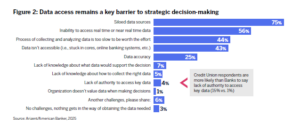
When data access runs through a need-to-know filter, the organization trains itself to stop reaching for data in the first place. People learn what works: don’t ask for the report, don’t wait three days, don’t burn political capital. Just make the best call you can with what you’ve got, and keep moving. That’s how “data-driven culture” quietly turns into “gut-driven operations,” even in banks spending seven figures a year on reporting teams.
Ron Shevlin was direct in our Data EQ webinar: the banks that move fastest treat data ownership as a leadership responsibility, not an IT service. Not because IT isn’t critical, but because a decision can’t wait its turn in a ticket queue. When data stays locked in one department, leaders assume the rest of the bank is seeing the same scoreboard. They’re not. The people closest to customers, risk, deposits, and lending are operating one delay behind, and by the time the numbers arrive, the moment has already changed.
This is why the frustration in these Phoenix hallways sound so familiar. It’s not that banks don’t value data. It’s that too many of them have built a system where data is something you request instead of something you use.