The browser you are using is not supported. Please consider using a modern browser.

Article
Banks Are Still Missing the Signals That Matter
 •
Dec 22, 2025
•
Dec 22, 2025
Banks don’t lose customers all at once. They lose them gradually — through small, nearly invisible cues hiding in the data they already have.
According to Cornerstone Advisors’ “Improving Your Financial Institution’s Data IQ” report, only 8% of banks believe they’re using data effectively to personalize customer experiences. That leaves 92% potentially overlooking behavioral shifts that point to customer disengagement, evolving needs, or opportunities for growth.
And it’s not just about the big payments anymore. Mortgage activity is easy to notice. What banks often miss are the smaller, faster-moving signals: a rent split over a payment app, recurring micro-investments, grocery purchases made from a new account. These are subtle shifts, but when seen together, they tell you everything about where a relationship is headed. Customers don’t just wake up one day and decide to leave your institution; they gradually move their trust, finances, and loyalty elsewhere. Your transaction data already holds those clues. The challenge is noticing them early enough to act.
The Subtle Signs
Banks lose business transaction by transaction. The patterns are often quiet:
- A deposit stops showing up
- A payment shifts to a competitor
- A business customer quietly routes revenue elsewhere
And behind each of these is a customer consciously making a decision to move away from their institution, often without ever saying a word. They’re not necessarily angry at their bank. They’re probably just “content.” But that feeling is exactly what allows competitors to steal wallet share.
Only 19% of survey respondents said they use transaction data to target and personalize offers at a “high” or “good” level at their institution. That’s not uncommon, especially with what we’re hearing in the industry. They know the potential is there, but it’s difficult to extract actionable, intelligent information from it in a timely manner. Not to mention, there’s an incredible amount of it.
That’s exactly why we launched our Transactional Intelligence module earlier this year. Because while the data is already there, the ability to spot the meaningful shifts — and respond before someone else does — is what really sets banks apart.
Governance Isn’t the Gap, But It’s Not the Goal Either
Cornerstone’s Data IQ findings revealed something important: banks feel most confident about governance. That’s a fantastic start. It means banks are getting better at defining ownership, establishing controls, and putting structure around how data is handled.
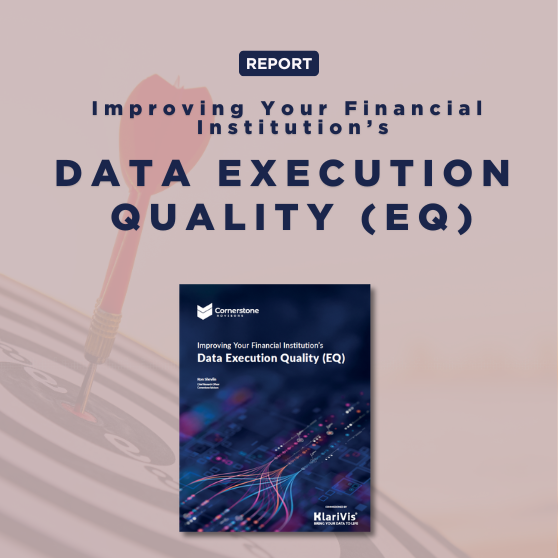
But even in this area, the confidence only goes so far. In Cornerstone’s more recent “Improving Your Financial Institution’s Data Execution Quality (EQ)” report, “data governance and stewardship policies” were among the highest-rated capabilities — but the average score still fell short of being fully established or strategic. In other words, banks may have frameworks in place, but executing against them in a consistent, enterprise-wide way is still a work in progress.
But governance isn’t the same as action.
Confidence in governance doesn’t mean a banker sees the right transaction trend in time to reach out. It doesn’t mean insights are flowing across teams in a way that supports proactive customer engagement. Especially when it comes to transaction data, governance needs to be a launchpad, not a silo.
The next step beyond governance is operational clarity. Banks that are succeeding ask: Are our teams aligned around how to use this data? Can staff see what matters, when it matters? Are we organized to act on what we know?
Executives echoed this shift at one of our Executive Data & Innovation Summits. As one put it, “KlariVis had become a communication tool. We’re all looking at the same thing.” When teams across lending, retail, and strategy all have access to the same view, and are trained to use it, clarity replaces chaos, and decisions move faster. The banks seeing real progress aren’t asking who owns the data: they’re asking who’s acting on it, when, and how often.
The research underscores the urgency. Fewer than one in four banking executives believe their institution is “good” at integrating data architecture into strategy or using it to drive operational workflows. Governance may be in place — but without integration and responsiveness, it’s an untapped asset.
Getting to Action, Quicker
Moving into 2026, banks are asking for more than another dashboard. They’re asking for better timing. A complete look at operational performance. The ones making progress are those surfacing the right information when it counts and giving it to the people who can actually do something about it.
These are subtle shifts in behavior, but they matter. The most forward-thinking banks are training their teams to respond in real time — not because they’re chasing efficiency, but because they’re focused on connection.
What’s at Stake
Banks have a choice: operate on assumptions or act on what the data is quietly telling you. Your customers don’t expect perfection. But they do expect to feel known, especially when their habits start to change. These signals don’t shout. Instead, they show up in the small changes: a shifted deposit, a recurring payment, a reduced balance. And once they’re missed, they’re rarely repeated.
Banks that win in this environment won’t be the ones collecting more data. They’ll be the ones noticing sooner and acting when it matters. The signals your customers are constantly sending don’t just “disappear.” They just go to someone else who’s paying attention.